

There is a particular kind of afternoon in Sri Lanka that is difficult to describe to someone who has never experienced it.
The air is warm but not heavy. The light comes sideways through the trees — golden, unhurried — and lands on everything with a kind of generosity that makes even ordinary things look significant. The pond is still. The lotus leaves sit on the surface like open palms, broad and patient, holding the light without trying to.
It was on one of those afternoons that everything changed.
A Moment of Stillness
I wasn’t looking for an idea that day. I wasn’t trying to start a brand or solve a problem or find a new direction. I was simply there — sitting beside a pond, watching the light move across the water, doing nothing particularly useful.
I reached down and lifted a lotus leaf from the surface. It came up whole, curved slightly at the edges, beaded with water that rolled off in perfect spheres. I held it up to the light.
What I saw stopped me completely.
The veins. Running from the centre outward in every direction — branching, dividing, growing finer and finer until they became almost invisible. Each one carrying something, connecting something, part of a system so intricate and so perfectly designed that no human mind could have drawn it.
I turned the leaf over in my hands. I pressed it lightly against my palm. The texture of it — the slight resistance, the coolness, the weight — felt like something that deserved to last longer than a single afternoon.
What if it could?
The First Experiment
That evening I went home and found a piece of fabric — nothing special, a rectangle of natural cotton I had been meaning to use for something else. I placed the lotus leaf on top of it. I arranged a few others alongside it, overlapping slightly, the way they had been sitting on the pond.
Then I rolled everything tightly together and placed it in a pot of steaming water.
I had read about eco printing — the process of transferring natural pigments from plants onto fabric using heat — but I had never tried it. I wasn’t sure it would work. I wasn’t sure of anything, really, except that I wanted to see what would happen.
I waited an hour. Then two. Then I turned off the heat and let it cool.
When I unrolled the fabric, I sat with it for a very long time before I said anything.
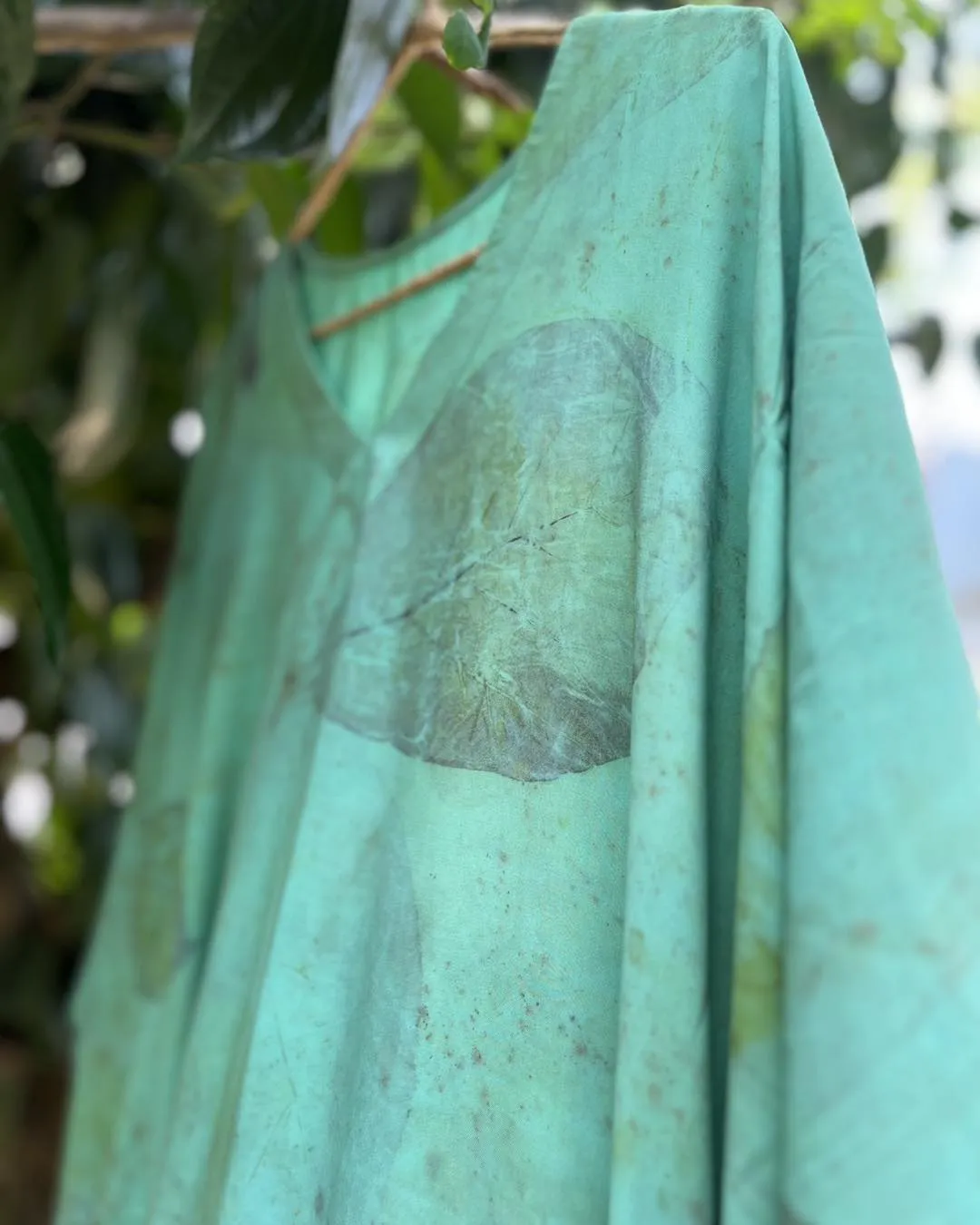
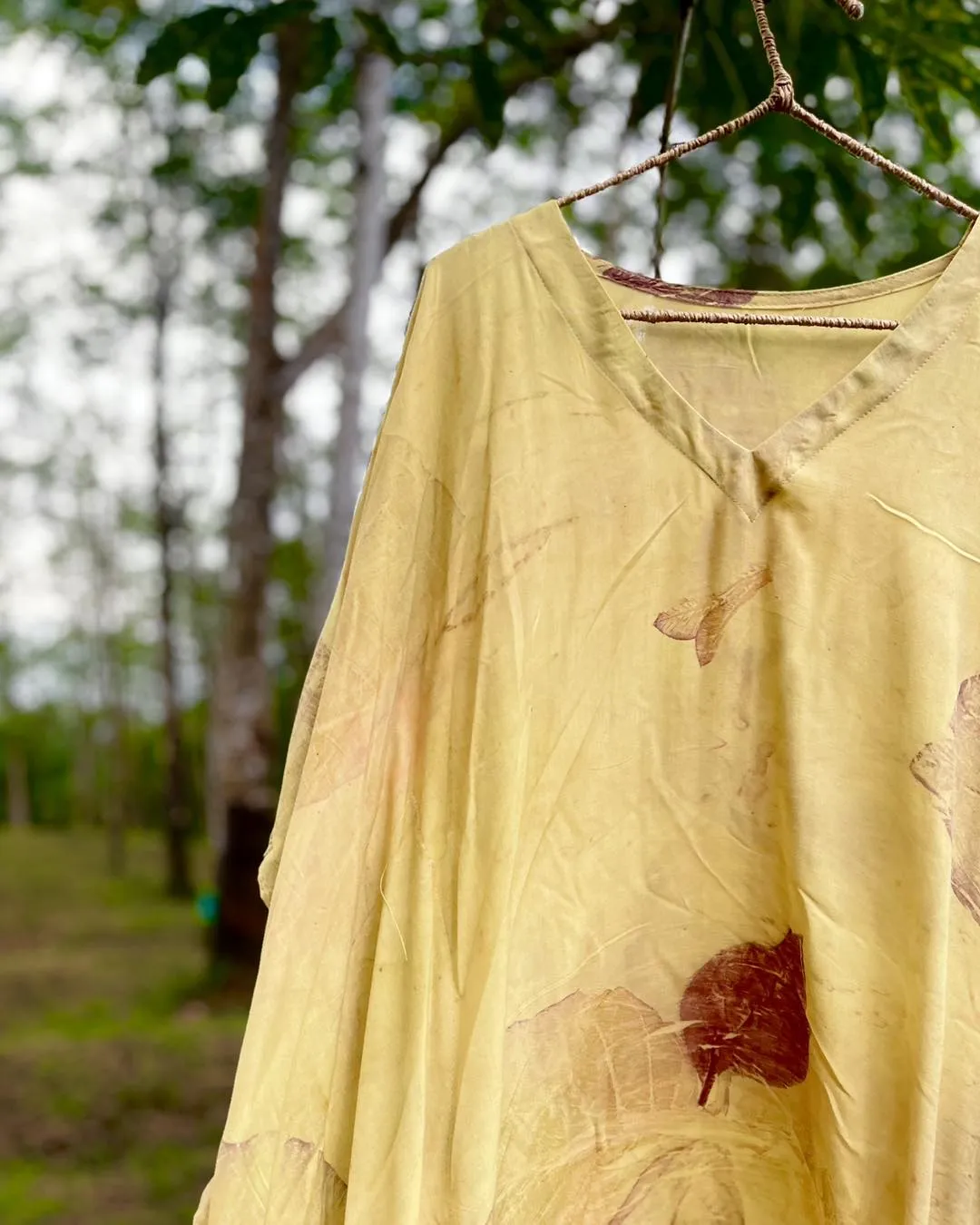
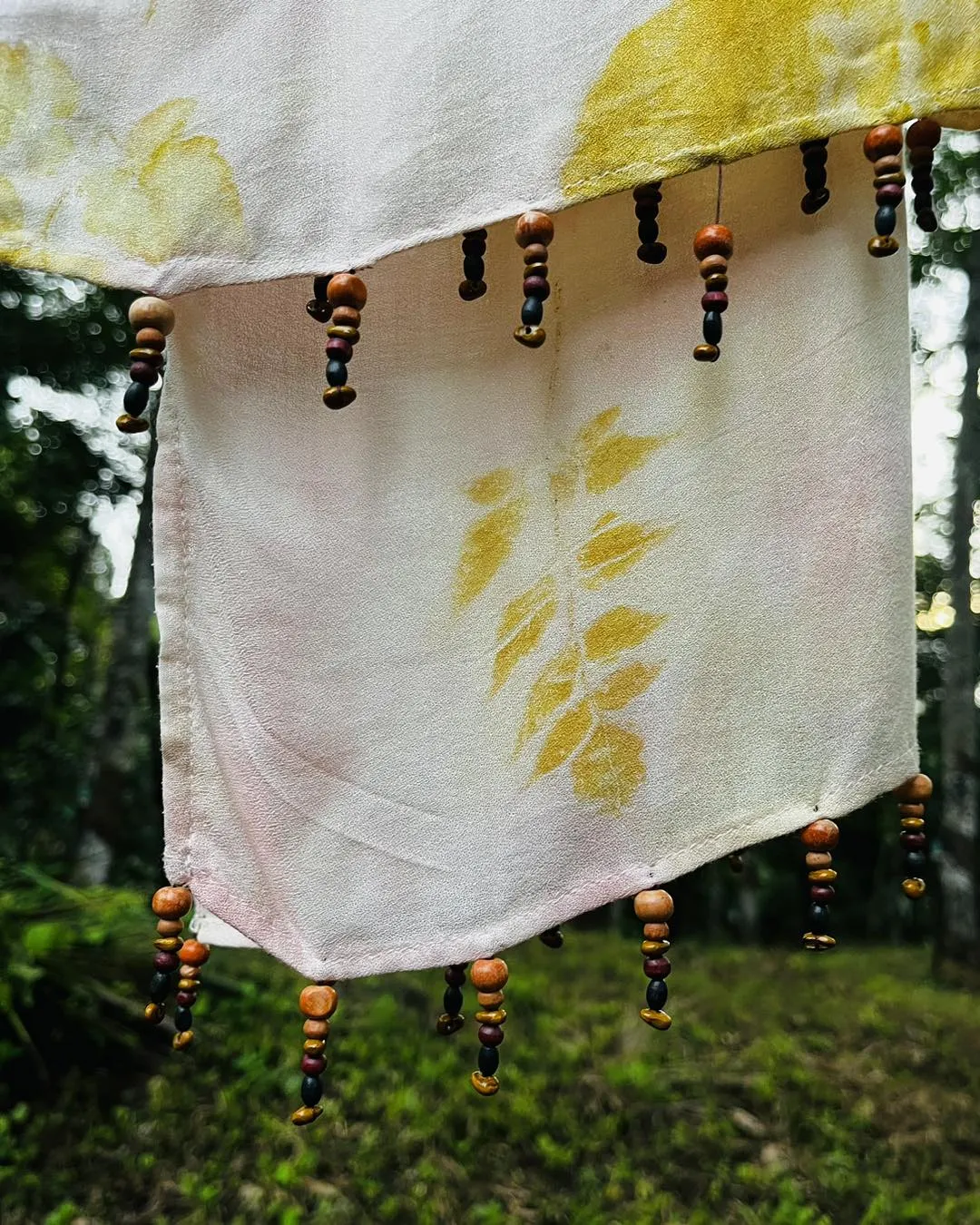
The prints were imperfect. The colours were softer than I had imagined — pale greens and dusty ochres and a deep, warm brown where the stem had pressed hardest into the cloth. The edges of the leaves had left ghost outlines, slightly blurred, as though the fabric had simply dreamed about the leaves rather than touched them.
It was not what I had expected.
It was better.
What Nature Knows That We Don’t
In the weeks that followed, I experimented constantly. Different leaves. Different fabrics. Different temperatures and rolling pressures and steaming times. I gathered fern fronds from the hillside, teak leaves from the road, banana leaves from the garden. I tried silk and linen and cotton blends. I failed often — colours that didn’t transfer, prints that smudged, fabric that puckered from the heat.
But in the failures, I learned something.
I learned that nature is not interested in consistency. It is interested in truth.
Every leaf prints differently because every leaf is different. A lotus leaf gathered in the dry season carries different pigments than one gathered after rain. A fern picked in the morning holds more moisture than one picked in the afternoon. The temperature of the steam, the tightness of the roll, the age of the leaf — all of it shapes what emerges. All of it matters.
There is no way to control the outcome entirely. There is no way to make two prints that are exactly the same. And the more I worked with this process, the more I understood that this was not a limitation.
It was the whole point.
The Question That Became a Brand
I kept coming back to one thought.
We live in a world that is absolutely full of things that look beautiful. Things that are designed to look beautiful, optimised to look beautiful, produced in their thousands to look beautiful in exactly the same way as every other version of themselves.
But how often do we hold something in our hands and feel — genuinely feel — that it is one of a kind? That it exists nowhere else in the world? That the specific combination of circumstances that created it will never occur again?
That is what a leaf print is. Not a design that happens to use natural imagery. Not an eco-friendly alternative to a synthetic print. A literal record of a specific leaf, on a specific day, in a specific place — pressed into fabric and preserved there permanently.
When you wear a LeeFloom garment, you are wearing a moment. A particular afternoon. A particular leaf. A particular quality of light.
That felt like something worth building around.
What We Are Still Learning
LeeFloom is young. We are still learning — about the process, about the plants, about the seasons and how they change what is possible. There are leaves we haven’t tried yet. Techniques we are still developing. Combinations of fabric and pigment and heat that we haven’t discovered.
Every time we open a steamed roll of fabric, there is still a moment of genuine uncertainty. We don’t know exactly what we’ll find. We never do. And we have come to love that moment — the held breath, the slow unrolling, the reveal.
It keeps us honest. It keeps us humble. It reminds us that we are not really the ones making these garments.
We are the ones who hold the fabric still while nature does its work.
An Invitation
If you have found your way to this journal, it is probably because something about what we do resonates with you. Maybe you are tired of things that look the same. Maybe you are drawn to the idea of wearing something that carries a real story — not a marketing story, but an actual, physical, traceable story rooted in a real place and a real moment.
We made LeeFloom for people like you.
Every piece in our collection began beside a pond, or in a forest, or at the edge of a garden — with someone reaching down, picking up a leaf, and holding it up to the light.
We hope that when you wear it, you feel that moment too.
| Five Things Fast Fashion Cannot Give You | Gentle, confident editorial about why slow and rare matters |
| What Happens When You Open the Roll | A minute-by-minute account of the reveal — the most intimate part of the process |