

Sri Lanka has two monsoons and two dry seasons, and if you live here long enough, you stop measuring time in months and start measuring it in weather.
The rains come and the landscape transforms — lush, almost overwhelmingly green, everything growing at a pace that feels urgent and alive. Then the rains stop, and a different kind of beauty takes over. Slower. Drier. More concentrated. The colours deepen and warm. The leaves change. The light changes.
And so does everything we make.
When the Rain Stops
The dry season arrives gradually, then all at once.
First, the afternoons grow longer and the shadows sharper. The ponds begin to recede at their edges, leaving a pale ring of dried earth around the waterline. The lotus leaves — our most beloved material — sit differently on the surface now. Lower. More deliberate. Their edges curl slightly upward as the moisture in the air decreases, as if they are cupping what little water remains.
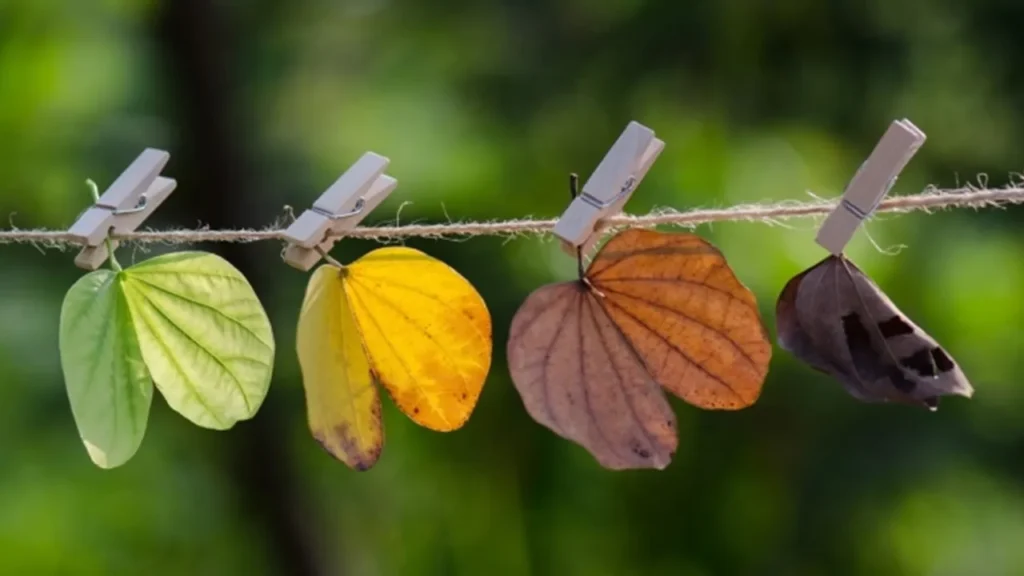
The forests thin at the margins. Leaves that were soft and saturated with rain become firmer, their surfaces more concentrated, their pigments pulled inward and deepened by the heat. A fern frond that printed pale silver-green in the wet season will print something closer to bronze in the dry one. A teak leaf that left a soft golden impression after the rains will leave something darker now — a deeper, earthier mark, the colour of old wood and afternoon shadow.
We gather differently in the dry season. More carefully. More selectively. There are fewer leaves to choose from, but the ones we find carry more — more pigment, more character, more of whatever it is that makes a print feel alive on the fabric.
The Palette of Dry Earth
If you laid out a year’s worth of LeeFloom garments in order of making, you would be able to tell exactly where in the season each one was created. Not because we label them that way, but because the colours tell you.
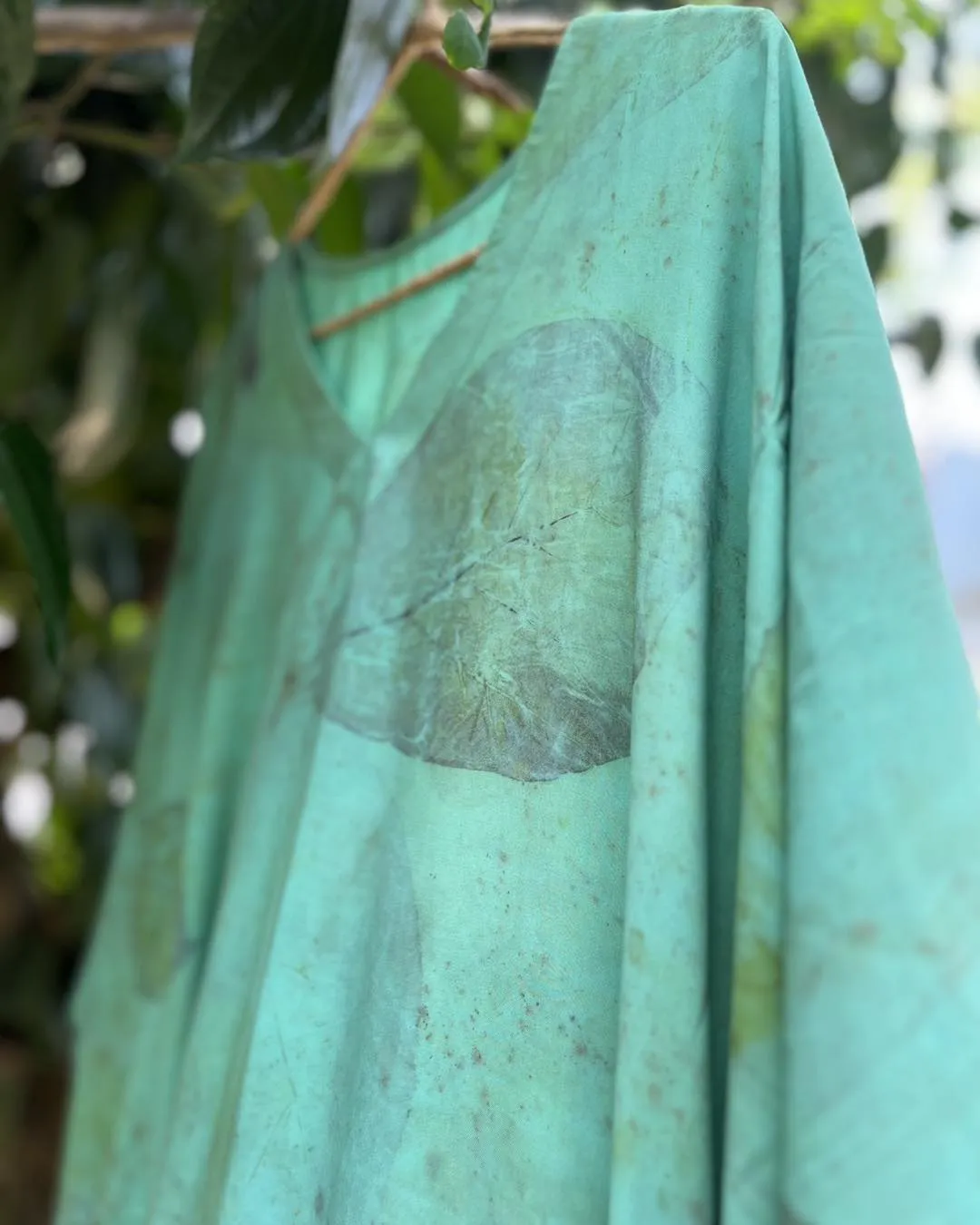
The wet season garments are cool and luminous. Greens that are almost blue. Soft grey-greens. Pale ochres. The prints are generous and fluid — the pigments spread easily in the moisture-rich air, bleeding slightly at the edges, giving the impressions a dreamy, watercolour quality that we love and cannot manufacture.
The dry season garments are something else entirely.
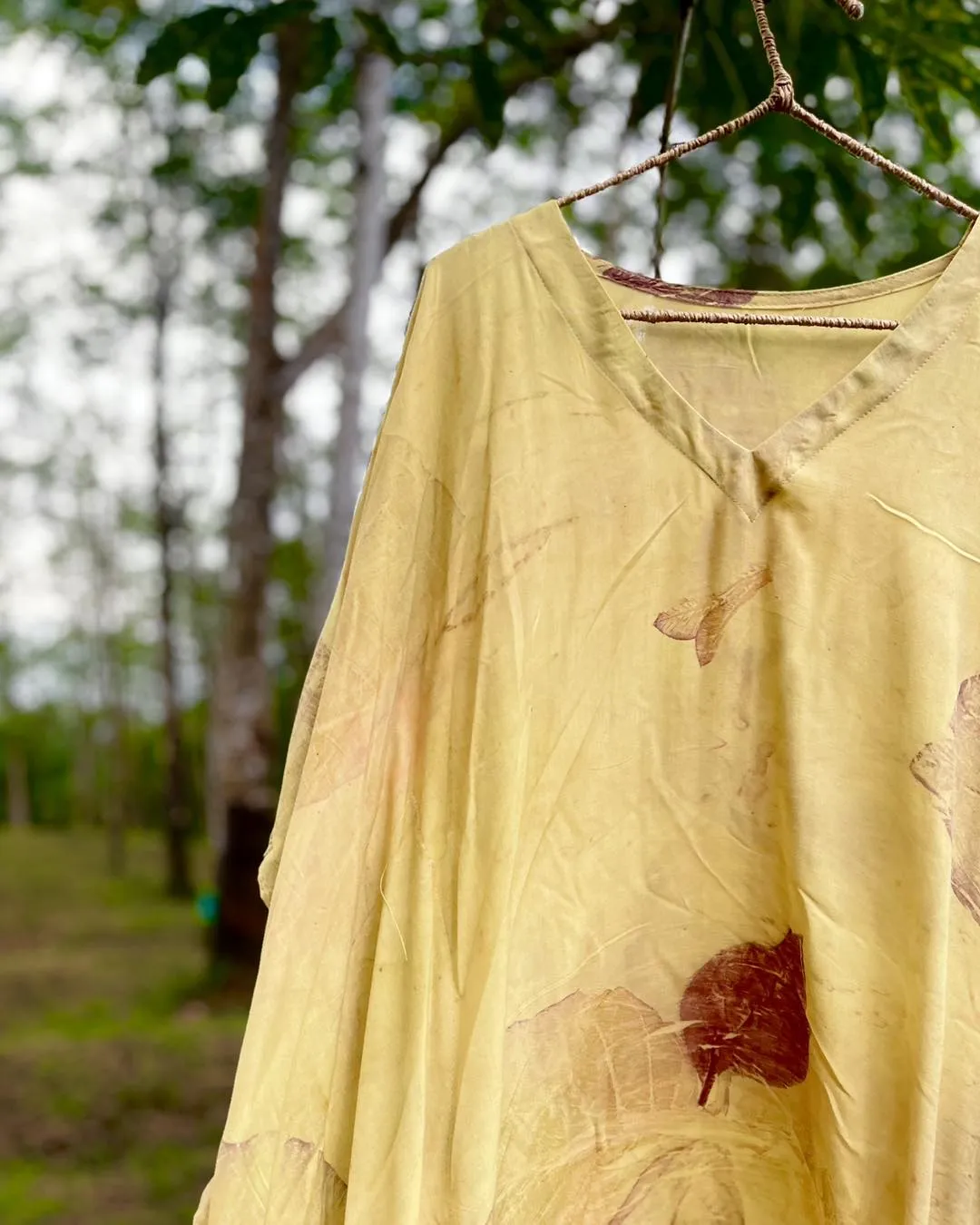
Amber. Deep and warm, the colour of late afternoon light on sandstone. It comes from leaves that have been concentrating their sugars and tannins through weeks of dry heat. Press one of these leaves onto silk, roll it tight, steam it slowly, and what emerges is a warmth that feels almost edible — rich and golden and slightly transparent, like honey held up to a window.
Rust and iron. Certain leaves — particularly the older teak and some of the roadside tropicals we gather from the drier hillsides — leave marks that lean towards red-brown in the dry months. Not quite red, not quite brown. Something in between that has no satisfying name in English but that feels, when you hold the fabric, unmistakably like soil. Like the specific colour of Sri Lankan earth when it has not seen rain for several weeks.
Deep olive. The lotus leaves, drier now and more leathery, print in deeper, more saturated greens that have an almost military quality — serious, structural, precise. The veining becomes more pronounced in these prints. More architectural. Less like a dream and more like a map.
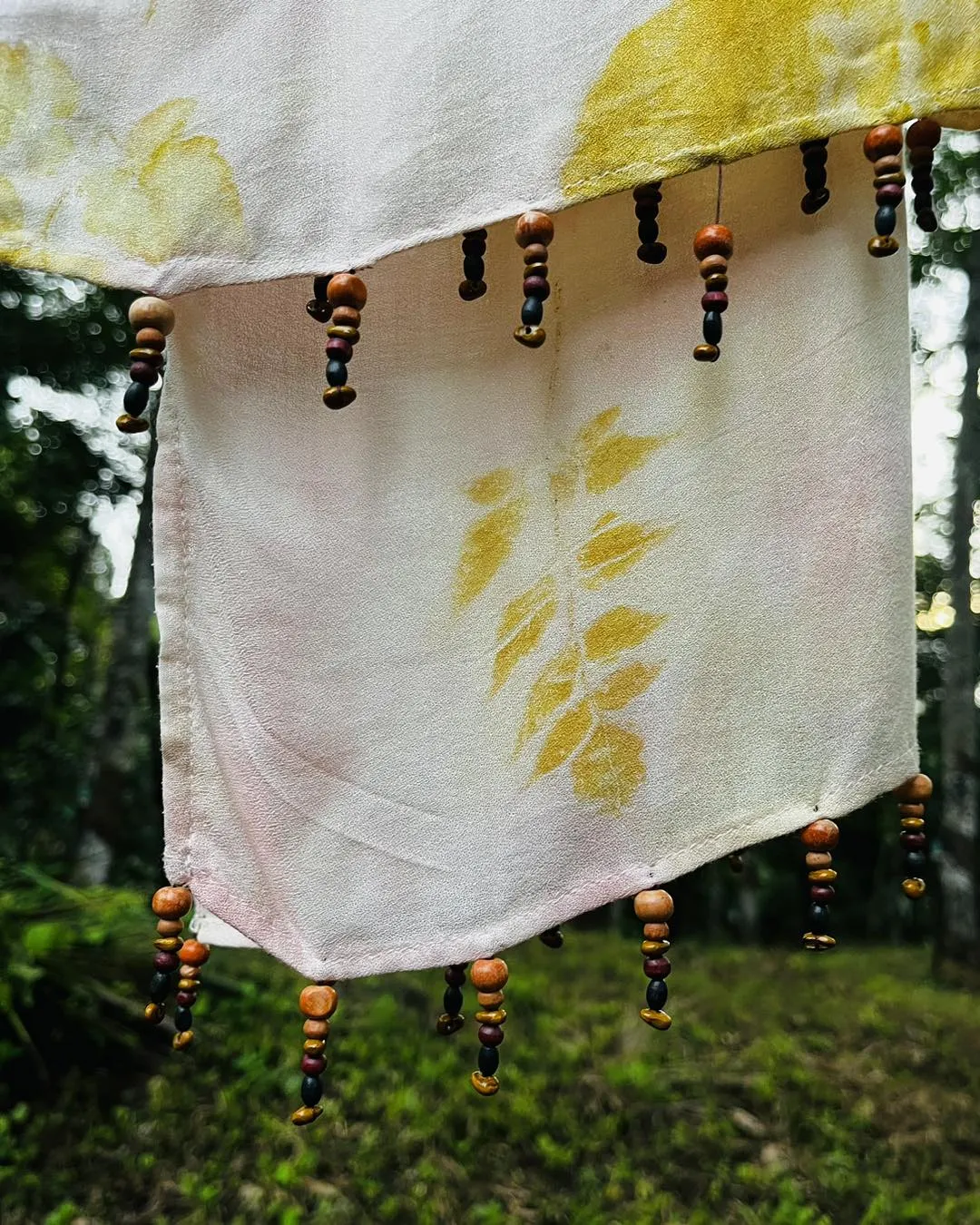
Pale bone. Between the deeper marks, the dry season leaves areas of the fabric almost untouched — a pale, warm off-white that reads like old parchment or bleached wood. These negative spaces feel intentional, even though they are entirely the result of how the leaf sat against the fabric and how the pigment decided to travel. We take no credit for them. We simply unfold the roll and find them waiting.
The Leaves We Seek in the Heat
Not every leaf survives the dry season well enough to print beautifully. Some dry too quickly and crumble before we can work with them. Some lose their pigment so completely that they leave almost nothing behind — ghost prints, traces, whispers of presence rather than marks.
But there are leaves that come into their own in the heat.
The lotus leaf in late dry season is perhaps our greatest surprise every year. We expect it to perform less well as the ponds recede and the leaves become more stressed. Instead, something interesting happens. The concentrated pigments in a leaf that has been working harder to survive — drawing up what little water remains, closing its pores against the heat, storing what it can — transfer with a depth and intensity that the well-watered wet season leaf rarely achieves.
There is something almost moving about this. The leaf that has struggled prints with more force. It leaves a more definite mark. It has more to say.
Dried fern, gathered from the hillside forests where the canopy keeps the worst of the heat at bay, prints in the dry season with extraordinary delicacy. The fronds become finer as they dry, their structure more visible, their geometry more precise. Pressed onto linen, they leave prints that look almost engraved — as if drawn with a very fine pen by someone with great patience and very steady hands.
Banana leaf, sun-baked and leathery, leaves marks that are broad and confident. The dry season version of a banana print is bolder, more graphic, the veins wider and more emphatically rendered. These prints suit our heavier fabrics — the thicker cottons, the silk blends — where they have room to expand into.
How Heat Changes the Steam
The eco printing process involves heat and moisture — two things that behave very differently in the dry season.
In the wet months, when the ambient humidity is high, the steam inside a rolled bundle distributes itself more evenly. The pigments travel freely. The prints can be more expansive, more spread, occasionally more unpredictable.
In the dry season, the air outside wants to pull moisture away from everything it touches. The fabric is drier when we begin. The leaves are drier. We have to adjust — more careful rolling, slightly longer steaming times, greater attention to how tightly the bundle is sealed — to coax the same transfer from a leaf that is holding its pigments more tightly than usual.
What this produces, when we get it right, is a print with more defined edges. More contrast between the leaf’s mark and the unmarked fabric. The dry season forces precision. It does not allow for the casual generosity of a wet season print. Every mark is more deliberate, more earned.
We have come to think of the dry season as the season of clarity. What is there is clearly there. What is not there is clearly absent. There is very little ambiguity in a dry season print — and that, in its own way, is a kind of beauty.
What You Are Wearing When You Wear a Dry Season Piece
We want to tell you something about the garments we make in these months, because we think it matters.
When you hold a LeeFloom piece made in the dry season — when you feel the weight of an amber-printed silk or run your finger along the deep olive veining on a lotus-printed cotton — you are holding more than a garment.
You are holding the specific reality of a Sri Lankan hillside or pond in the dry months of the year. The particular quality of sunlight at three in the afternoon when the heat is at its peak and the shadows are at their sharpest. The slightly stressed beauty of a leaf that has been working harder than usual to stay alive.
You are holding the season itself.
This is what we mean when we say that every LeeFloom garment is one of a kind. It is not marketing language. It is literally true. The dry season of this year will never come again. The leaves we gathered last Tuesday will never exist again in exactly this form. The temperature of the air on the afternoon we steamed this particular piece will never be precisely replicated.
The garment in your hands is the only record of all of that. It is a document. A pressed flower, but wearable. A piece of a specific time in a specific place, carried forward.
A Personal Note
I want to be honest about something.
The dry season is not always easy to work in. The heat in the studio is significant. The leaves are more demanding. The process requires more patience, more adjustment, more willingness to sit with uncertainty and wait for the right conditions.
There are days in the dry months when a steamed roll is opened and what we find is not what we hoped for. A print that is too faint, or too concentrated in one area, or that has shifted during steaming in a way that feels like failure.
On those days, it would be easy to add something — a dye, a fixative, a chemical shortcut that would give us more control and more consistency.
We don’t. We never have. We won’t.
Because the day we start controlling the outcome completely is the day the garments stop being what they are. They would become illustrations of nature rather than actual nature. Beautiful, perhaps. But not real.
We would rather have a difficult dry season and difficult prints than easy, predictable ones. The difficulty is part of what makes the beautiful ones matter.
The Garments of This Season
The pieces we are releasing this month were made during the height of the dry season. You will see it in the colours — warmer, deeper, more concentrated than our wet season work. The ambers. The deep olives. The rust-touched ochres.
Each one was made on a specific day. Each one was shaped by the specific leaves we gathered that week, the specific heat of the studio, the specific quality of the afternoon light coming through the window while we worked.
They will not be made again.
If something in our current collection speaks to you, we would gently say: don’t wait. Not because we are trying to create artificial urgency, but because this is simply how it works. When they are gone, this particular dry season goes with them.
And the next season will make its own entirely different garments.
Coming Next
In our next journal entry we will be writing about the lotus — its significance in Sri Lankan culture, why it has been considered sacred for thousands of years, and what it is about the structure of a lotus leaf that makes it print the way it does.
Until then, we hope you find yourself somewhere quiet, with good light, noticing the colours of whatever season you are in.
Seasonal Stories Author: LeeFloom Team · Sri Lanka